✓ Reviewed by the Bloomtivo teaching team · October 2026
The teacher your child learns with can shape how they feel about the Quran for years to come. A patient, qualified teacher can turn a nervous beginner into a confident reader who looks forward to every lesson. The wrong match can make the same child dread it.
With so many online options, choosing can feel overwhelming. This checklist will help you ask the right questions and spot the right teacher quickly.
- Look for real Quran qualifications, ideally an ijazah.
- Patience and warmth with children matter as much as knowledge.
- Prefer live 1-to-1 lessons, a free trial and regular progress updates.
- Ask about safeguarding, and trust how your child feels after the trial.
1. Real Quran qualifications
The first question to ask is simple: who taught the teacher? In the Quran tradition, a strong sign of a qualified teacher is an ijazah: a certification, passed from teacher to student, showing that the teacher recited to a qualified scholar and was approved to teach. Many ijazahs are connected through a chain of teachers going back many generations.
It is also worth asking where the teacher studied. A background in Islamic studies or Arabic, for example at Al-Azhar University, shows that the teacher understands what they teach, not just how to recite it.
2. Patience and a love for teaching children
Teaching adults and teaching children are very different skills. A great children’s teacher:
- speaks gently and keeps a calm, encouraging tone,
- corrects mistakes without making the child feel embarrassed,
- uses praise, stories and small games to keep young minds engaged,
- knows when to slow down, and when your child is ready for more.
Knowledge without patience rarely works with children. Look for both.
3. Live 1-to-1 lessons
Group classes have their place, but for learning to read the Quran, 1-to-1 lessons are hard to beat. The teacher hears every single sound your child makes, corrects it immediately and moves at your child’s pace. Shy children also tend to open up more when they are not reading in front of others.
4. A male or female teacher, your choice
Many families have a clear preference, especially as children grow older. A good academy should offer both male and female teachers and respect your choice without question.
5. Safeguarding and safety
Your child’s safety comes first, online as much as anywhere else. Do not be shy about asking:
- Does the academy have a written safeguarding policy?
- Can I sit with my child during lessons?
- Who do I contact if I have a concern?
A trustworthy academy will be happy to answer. You can read our own Safeguarding Policy as an example of what to look for.
6. Clear progress you can see
You should never have to guess how your child is doing. Ask how progress is tracked and shared. Regular updates, such as a monthly progress report, show what your child has learned, where they need help and what comes next.
7. Times that fit your family
For families in the UK, it matters that lessons fit around school, homework, clubs and weekends. Check that the teacher is available at UK-friendly times, and that lesson lengths suit your child’s age.
8. A real free trial
Finally, never commit before your child has met the teacher. A proper trial lesson lets you see the teacher’s style, and it lets your child decide how they feel. Ask what happens if it is not the right match: can you change teacher easily?
Watch your child, not just the lesson. After the trial, ask your child one question: “Would you like to see this teacher again?” Their answer tells you a lot.
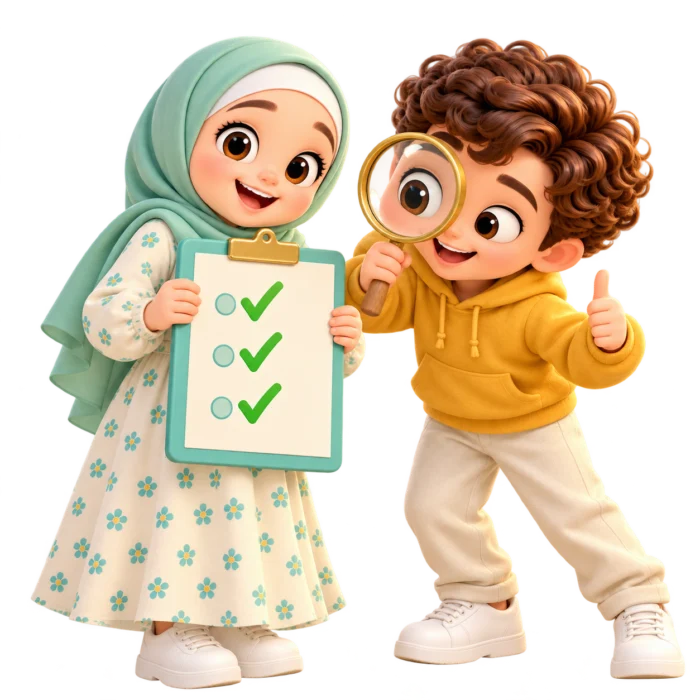
Your trial-lesson scorecard
Keep this open during the trial. A quick tick or note next to each line makes comparing teachers much easier.
| What to check | A good sign looks like |
|---|---|
| Qualifications | The teacher can tell you who they learned from and which ijazah they hold. |
| Your child’s comfort | Your child relaxes as the lesson goes on and answers more freely. |
| Corrections | Mistakes are corrected clearly and kindly, and your child tries again. |
| Communication | The teacher explains what they covered and what to practise at home. |
| Safety | Contact and scheduling go through you, never privately to your child. |
| Fit | The lesson length and times suit your child’s energy and your family week. |
A note from the Bloomtivo Teaching Team
During a trial lesson, a child stumbled over a word and went quiet. The parent had been listening for the teacher’s qualifications, but that small pause showed them something just as important.
The teacher waited, gave the child time, then modelled the sound without making the mistake feel like a problem. The child tried again. It was not perfect, but they continued reading.
Afterwards, the parent asked, “What happened when you got stuck?” The child replied, “The teacher helped me do it again.”
That answer told the parent more than a general question about whether the lesson was fun. A trial is a chance to see how a teacher responds when learning gets difficult: whether the child feels safe enough to try again, and whether the correction actually helps.
— The Bloomtivo teaching team
Questions to ask during the trial
- What qualifications and ijazah do you hold?
- How do you teach young children who find it hard to focus?
- Where would you start with my child, and why?
- How will I know my child is making progress?
- What happens if my child does not get on with you?
Red flags to look out for
- No trial lesson, or pressure to pay before your child has met the teacher.
- A teacher who seems distracted, rushed or impatient.
- Harsh corrections that leave your child upset.
- No clear plan and no way of seeing progress.
How we choose our teachers at Bloomtivo
We built Bloomtivo around everything on this list. All our teachers hold ijazahs in the Quran, many studied at Al-Azhar University, and they are chosen for their patience with children. Lessons are live and 1-to-1, with male and female teachers, 7 days a week at UK-friendly times, and parents receive a monthly progress report. Every child starts with 2 free trial lessons, and if the teacher is not the right match, we change the teacher and the trial lessons stay free until your child is comfortable.
You can meet some of our teachers, see all our programmes, or simply book a free trial and see for yourself.
Sources and further reading: Keeping children safe online (NSPCC) · Bloomtivo safeguarding policy