
Few moments fill a parent’s heart like seeing your child stand beside you in prayer for the first time. Teaching salah is one of the greatest gifts we can give our children, and one of the most important responsibilities we carry.
And yet, if we are honest, it can also feel a little daunting. Where do you start? How do you teach wudu, the movements and the words without nagging, pressure or tears? And what if your child just isn’t interested yet? You are not the only parent asking. This step-by-step guide walks you through it gently, one small piece at a time.
- The Prophet ﷺ guided parents to teach children to pray from the age of seven.
- Start earlier through example: let little ones pray beside you.
- Teach wudu first, then the prayer, one small part at a time.
- Gentleness, praise and praying together build a love for salah that lasts.
When should children start praying?
The Prophet ﷺ guided parents to teach their children to pray when they reach seven (Sunan Abi Dawud 495). That does not mean nothing happens before seven. Long before then, children learn by watching. When a toddler lays a mat beside you and copies your movements, they are already learning that prayer is a beautiful part of family life.
A good way to think about it:
- Before seven: watching, copying and joining in for fun, with lots of love.
- From seven: learning wudu and the prayer properly, step by step, and building the habit.
- As they grow: praying all five prayers on time, with understanding.
Step 1: Begin with the why
Before the how, share the why. Explain, in simple words, that salah is our special time to talk to Allah, to thank Him and to ask Him for what we need, five times a day. Children who understand that prayer is a conversation with Allah are far more likely to love it.
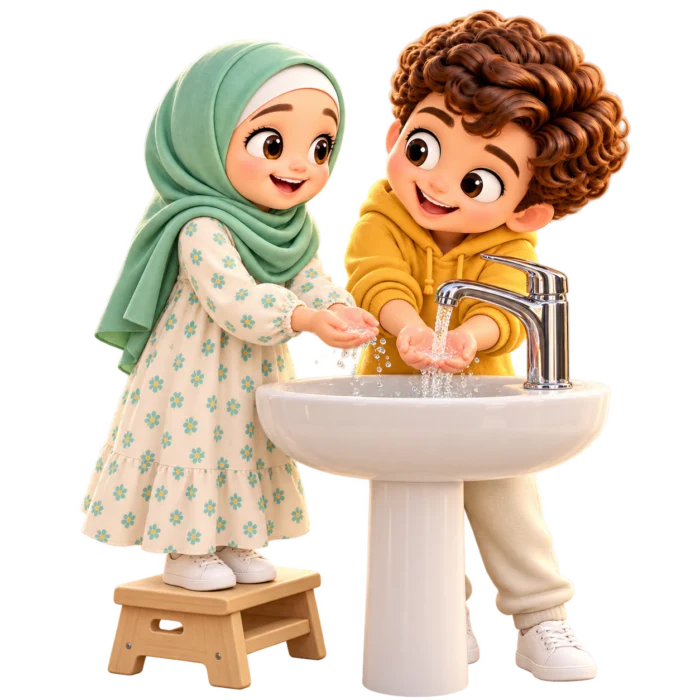
Step 2: Teach wudu
Wudu is the washing we do before prayer, described in the Quran (Surah Al-Ma’idah 5:6). Teach it at the sink, slowly, doing it together:
- Make the intention in your heart and say Bismillah.
- Wash the hands up to the wrists.
- Rinse the mouth.
- Rinse the nose.
- Wash the face.
- Wash the arms up to and including the elbows, right first.
- Wipe over the head with wet hands, and the ears.
- Wash the feet up to and including the ankles, right first.
Make it fun: count the washes together, and praise your child every time they remember the order.
Step 3: Learn the movements
The Prophet ﷺ said: “Pray as you have seen me praying.” (Sahih al-Bukhari 631). Children learn salah the same way: by seeing it. Pray slowly beside your child and name each position:
- Standing (qiyam) and saying Allahu Akbar to begin.
- Bowing (ruku‘) with a straight back.
- Standing up again.
- Prostrating (sujud), with the forehead and nose, both hands, both knees and the toes touching the ground.
- Sitting between the two prostrations.
- The final sitting and ending with the salam to the right and left.
Step 4: Learn the words, little by little
Do not try to teach everything at once. Start with Allahu Akbar and Surah Al-Fatihah, then add a short surah, then the words said in ruku‘ and sujud, and later the words of the final sitting. Learning what each part means makes the prayer come alive. Our Quranic Arabic programme helps children understand what they say.
Teacher’s tip: give your child their own small prayer mat. Something that is truly “theirs” makes children proud and excited to pray.
Step 5: Build the habit
- Pray together whenever you can, especially Maghrib and Isha at home.
- Link prayers to daily moments: Fajr before breakfast, Maghrib before dinner.
- Start with one or two prayers a day and add more as the habit grows.
- Celebrate progress, like the first week of praying Maghrib every day.
Keep it gentle
Some days your child will rush, forget or not feel like praying. That is normal. Stay calm, remind gently and keep praying beside them. Children remember how prayer felt in their home: let it feel warm, safe and full of love.
A note from Islam Awny and Mahmoud Tantawy, Quran & Islamic Studies Teachers at Bloomtivo
A parent said, “My child knows how to pray, but every salah becomes an argument.” When we talked it through, the child could copy the movements but did not always know what came next. The reminders were arriving when the family was already rushing.
We suggested practising one small part at a calm time, outside the pressure of prayer. The parent and child chose the movements they found confusing and went through them together slowly. At prayer time, the reminder became shorter: “Come and stand with me,” rather than a list of corrections.
The arguments did not disappear overnight. But the parent could now tell when the child needed help remembering the steps and when they simply needed a moment to finish what they were doing.
Teaching salah includes the movements, but it also includes learning how to invite a child into the routine without turning every reminder into a battle.
— Islam Awny and Mahmoud Tantawy, Quran & Islamic Studies teachers at Bloomtivo
A simple 4-week starter plan
If you are starting from the beginning with a child of around seven, this gentle plan keeps things small and doable. Move on only when your child feels comfortable.
| Week | Focus | What it looks like at home |
|---|---|---|
| Week 1 | The why, and wudu | Talk about why we pray. Make wudu together at the sink once a day. |
| Week 2 | The movements | Pray Maghrib together. Your child copies the positions beside you while you name each one. |
| Week 3 | The first words | Add Allahu Akbar and Surah Al-Fatihah, said together slowly. |
| Week 4 | Growing the habit | Add the words of ruku‘ and sujud, and a second prayer, such as Isha. |
To make it easier, print our free Wudu Steps poster for the bathroom, and get the free How to Pray guide with a weekly prayer tracker.
Common questions parents ask
What if my child makes mistakes in the prayer? Correct gently, after the prayer, and praise them for praying. Mistakes are part of learning.
Should I teach the meanings or just the words? Both. Start with the words, then explain their meanings bit by bit, so prayer becomes a real conversation with Allah.
A teacher can help
Teaching salah at home can be easier with support. Our Salah & Wudu programme teaches wudu and every part of the prayer step by step, in live 1-to-1 lessons with patient, qualified teachers. You can sit nearby and practise together. It pairs beautifully with Duas & Adhkar. Start with 2 free trial lessons.
Sources and further reading: Sunan Abi Dawud 495 (Sunnah.com) · Sahih al-Bukhari 631 (Sunnah.com) · Surah Al-Ma’idah 5:6 (Quran.com)