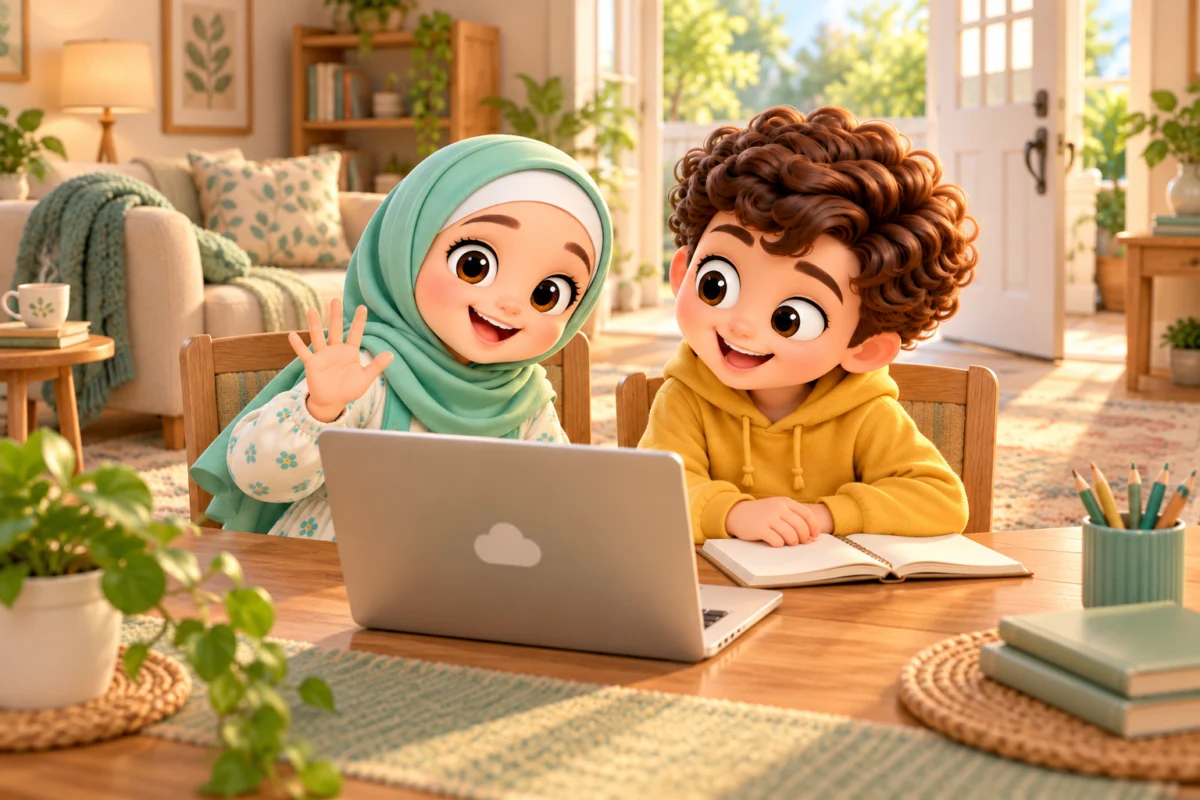
Yes, online Quran learning can be a very safe way for children to learn, as long as two things are true: the academy has clear safeguarding rules that it actually follows, and you, the parent, stay involved. Learning at home, in a room you choose, with you nearby, gives you more visibility than most activities outside the house.
If you have ever felt a flicker of worry about someone teaching your child through a screen, that instinct is a good one. It means you care. The answer is not to avoid online learning; it is to know exactly what to look for.
Below is a simple checklist you can use before you choose any online teacher, the red flags that should make you stop, and easy rules that keep lessons safe at home.
- Choose an academy with a written safeguarding policy and a clear way to raise concerns.
- All contact should go through you, the parent, never privately with your child.
- Keep lessons in a shared room, with you close by, especially for younger children.
- Talk to your child: they should know they can always tell you if something feels wrong.
The parent’s safety checklist
Before booking lessons, ask these questions. A good academy will be happy to answer every one of them clearly.
- Is there a written safeguarding policy? It should explain how children are protected, what teachers may and may not do, and who to contact with a concern.
- How are teachers chosen? Ask about their qualifications in the Quran (for example an ijazah), their experience with children, and how the academy checks and supervises them.
- Can I watch or sit in on lessons? The answer should always be yes.
- Does all communication go through the parent? Scheduling, messages and feedback should come to you, not to your child directly.
- Can I choose a male or female teacher? Many families have a preference, especially for daughters. A good academy will respect it.
- How does the teacher handle mistakes? A good teacher encourages a child who gets something wrong. A child who is shouted at or embarrassed learns to fear the lesson, not to love the Quran.
- Are lessons recorded? If they are, ask who can watch the recordings, how long they are kept, and whether your permission is asked first.
- What happens if my child is not comfortable? You should be able to change teacher easily, without pressure.
- Will I get regular updates? Progress reports keep you informed about what your child is learning and how lessons are going.

Red flags: when to stop and ask questions
Whatever the subject, these are warning signs in any online lesson with a child:
- A teacher asks your child to message them privately, add them on social media or move to a different app.
- A teacher asks your child to keep something secret from you.
- Your child suddenly starts making excuses to skip a lesson they used to enjoy.
- Gifts, money or personal favours are offered to your child.
- Lessons happen at times or in ways you did not agree to.
- There is no clear person to contact at the academy when you have a concern.
If you notice any of these, pause the lessons and raise it with the academy straight away. For urgent worries about a child’s safety in the UK, you can also contact the police or the NSPCC.
Simple safety rules at home
- Use a shared space. The living room or kitchen table is ideal. Avoid bedrooms with the door closed.
- Stay within earshot. For young children, sit nearby for at least the first lessons. For older children, pop in now and then.
- Use your account. Set up lessons from a parent’s account or device, not a child’s private one.
- Check the device. Keep parental controls on, and close other apps and tabs during lessons.
- Protect personal details. Teach your child not to share their address, school or passwords online.
Teacher’s tip: say hello to the teacher at the start of the first few lessons and stay for a few minutes. Your child feels more relaxed, and you get a real sense of the teacher’s manner.
Talk to your child
The most powerful safety tool is a child who knows they can tell you anything. In simple words, explain that a teacher should never ask them to keep secrets, and that they will never be in trouble for telling you if something felt strange or uncomfortable. Ask them after lessons what they learnt and how they felt, so talking about lessons becomes normal.
The NSPCC has excellent, practical advice on keeping children safe online, which applies to every kind of online activity, not just Quran lessons.
From a teacher: “He used to love his Quran lesson”
A mother once called me, very upset. “Ustadh Islam, my son used to love the Quran. Now he hates his lesson and doesn’t want to carry on.” He used to count the days until each lesson. Then, every time lesson time came near, he started finding excuses: “I don’t want to go in today.”
I asked her, “Have you asked him why?” She said, “He only says he isn’t comfortable with the teacher.”
When I spoke to her son calmly, the picture became clear. His previous teacher used to embarrass him whenever he made a mistake, and had been messaging him privately without his parents knowing.
The problem was not learning the Quran online. The problem was that nobody was keeping a close enough eye on the lessons. So I always tell parents: don’t judge lessons only by how well your child memorises and recites. After every lesson, ask:
- Did you enjoy today’s lesson?
- How did your teacher treat you?
- Was there anything that upset you?
And really listen to the answer. Real success is not just a new surah memorised. It is a child who learns the Quran feeling safe, comfortable and loved. Your child’s sense of safety is not a luxury; it is the foundation of good teaching.
— Islam Awny, Quran teacher at Bloomtivo
Is online safer than a local class?
Both can be safe when they are well run. Online lessons have some real advantages: there is no travel, your child stays at home, and you can see and hear the lesson whenever you like. If you are deciding between the two, read our honest comparison of online Quran classes and the local madrasa, and our guide on how to choose the right online Quran teacher.
How we keep lessons safe at Bloomtivo
Safeguarding is not an extra at Bloomtivo; it is part of how we teach. Parents are always welcome to sit in on lessons, and we follow a written safeguarding policy that you can read at any time. We have both male and female teachers, so you can tell us your preference, and all our teachers hold an ijazah in the Quran. You receive a progress report every month. And if your child is not comfortable with their teacher during the 2 free trial lessons, we change the teacher and the lessons stay free until your child is happy, before you continue on a paid plan.
Sources and further reading: Keeping children safe online (NSPCC) · Bloomtivo safeguarding policy