The Arabic alphabet has 28 letters. It is written and read from right to left, most letters change their shape depending on where they sit in a word, and the short vowels are small marks above or below the letters. The easiest way to teach children is to start with the sounds, group letters that look alike, and practise a little every day.
And if you didn’t grow up reading Arabic yourself, please don’t worry. You can learn alongside your child, one letter at a time, and that shared learning is often what children remember most.
This guide gives you a simple step-by-step plan you can follow at home, the letter “families” that make learning faster, and playful activities that keep young children interested.
- There are 28 letters, read from right to left.
- Many letters share the same shape and differ only by their dots, so teach them in families.
- Most letters join to the next letter and change shape slightly; six letters never join to the letter after them.
- Ten minutes a day with lots of praise works better than one long lesson a week.
The 28 letters
ا ب ت ث ج ح خ د ذ ر ز س ش ص ض ط ظ ع غ ف ق ك ل م ن ه و ي
Read them from right to left, starting with alif (ا) and ending with ya (ي). It is the same alphabet used in the Quran, so every letter your child learns brings them closer to reading the words of Allah, who says: “Indeed, We have sent it down as an Arabic Quran so that you may understand” (Surah Yusuf 12:2).
Step 1: Start with sounds, not names
Children learn faster when they first hear what a letter sounds like. Say “b” for ب before you introduce its name, ba. Most Arabic letters have a close match in English, so begin with those: ب (b), ت (t), م (m), ن (n), ل (l), ف (f), س (s).
Step 2: Teach letters in families
Many Arabic letters share exactly the same body and differ only in the number or position of dots. Teaching them together saves time and helps children notice the details.
| Family | Letters | What changes |
|---|---|---|
| The boat | ب ت ث | One dot below, two dots above, three dots above |
| The hook | ج ح خ | Dot inside, no dot, dot on top |
| The corner | د ذ | No dot, one dot |
| The slide | ر ز | No dot, one dot |
| The teeth | س ش | No dots, three dots |
| The loop | ص ض | No dot, one dot |
| The tall loop | ط ظ | No dot, one dot |
| The open mouth | ع غ | No dot, one dot |
| The circle head | ف ق | One dot, two dots (and a deeper tail for ق) |
The friendly names (“the boat”, “the hook”) are just a memory trick. Children love inventing their own.
A note from Sondos Hassan, Arabic & Quran Teacher at Bloomtivo
I once watched a child point confidently to ب، ت and ث, then give the same name for all three. My first instinct was to ask again, more slowly. It did not help. The child was looking at the letters as a family, but the dots had not become meaningful yet.
So we stopped naming the letters and made the dots the whole activity. I drew the shared shape on a small board and gave the child separate counters to place above or below it. One counter below: ب. Two above: ت. Three above: ث.
The child began checking the dots before answering. That small pause mattered more than getting the letters right quickly. We had found the missing step: the child did not need a longer list to memorise; they needed to notice what changed.
When a child mixes up a letter family, I now ask myself first: have they really seen the difference yet?
— Sondos Hassan, Arabic & Quran teacher at Bloomtivo
Step 3: Practise the tricky sounds
A few Arabic sounds do not exist in English, so English-speaking children need extra practice with them:
- ع (ayn) and ح (ha): made deep in the throat.
- خ (kha) and غ (ghayn): a little like clearing the throat, gently.
- ق (qaf): a “k” made further back, near the throat.
- ص ض ط ظ: “heavy” letters, said with a fuller mouth.
- ث (tha) and ذ (dha): like “th” in “three” and “this”.
These sounds are easiest to learn by listening to someone say them correctly and copying. Mistakes picked up now can stay for years, which is why many parents choose a teacher for this part. Our guide to Tajweed for kids explains why correct pronunciation matters so much in the Quran.
Step 4: Learn the letter shapes
Arabic is joined-up writing. Most letters connect to the next one and change shape slightly depending on whether they are at the start, middle or end of a word, or standing alone. For example, ب looks like this:
ب بـ ـبـ ـب
The good news: six letters never join to the letter after them: ا د ذ ر ز و. Learning this short list early makes reading much easier.
Step 5: Add the short vowels
Short vowels in Arabic are small marks called harakat:
- Fatha (a small line above) gives an “a” sound: بَ (ba).
- Kasra (a small line below) gives an “i” sound: بِ (bi).
- Damma (a small curl above) gives an “u” sound: بُ (bu).
Once your child knows the letters and these three marks, they can start reading real syllables, then short words. This is exactly how the Noorani Qaida works: one small step at a time, from letters to fluent Quran reading.
Fun ways to practise at home
- Letter hunt: stick letter cards around the house and let your child find the one you call out.
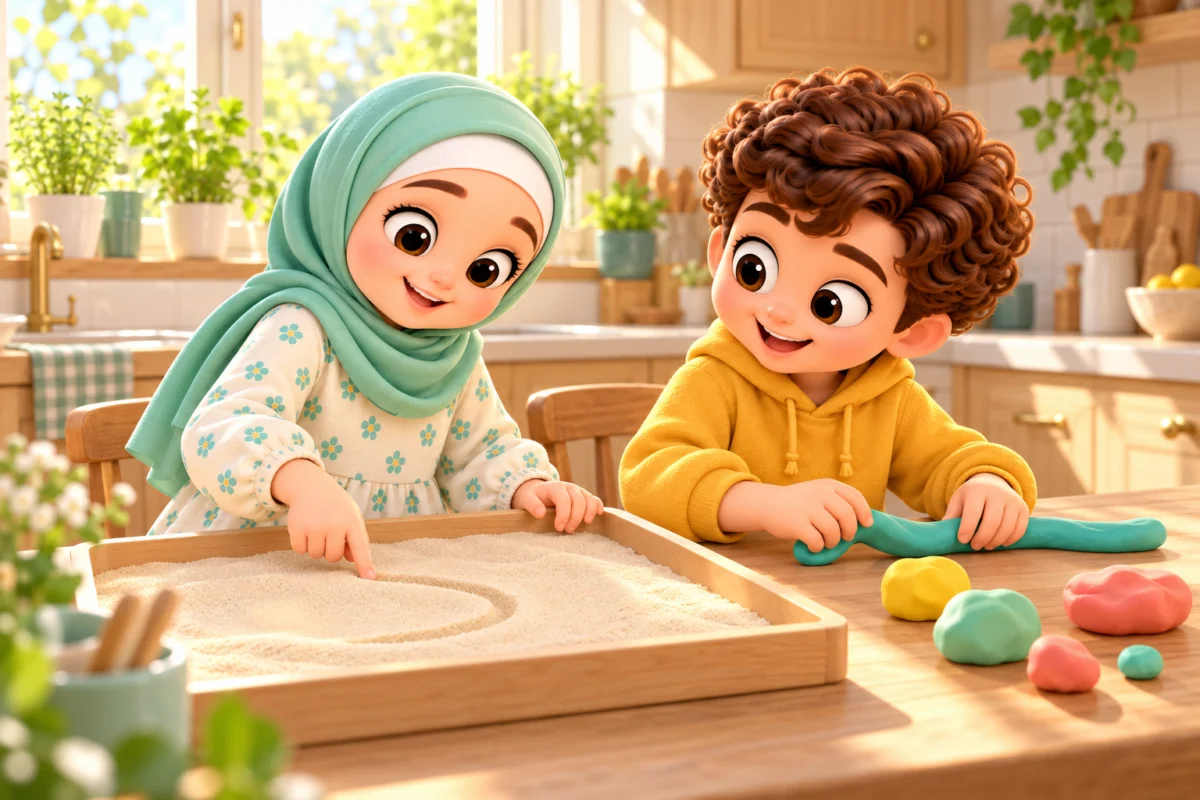
- Make the shapes: form letters with play dough, pipe cleaners or a finger in a tray of sand or salt.
- Dot detective: show a letter family and ask, “How many dots? Above or below?”
- Letter of the week: pick one letter and spot it on food packets, books and signs.
- Read to you: let your child “teach” you the letters they know. Children remember best what they explain.
Teacher’s tip: stop while your child is still enjoying it. Ending on a happy note makes them ask for the next lesson, instead of dreading it.
How long does it take?
Every child is different. Age, focus and, above all, regular practice make the biggest difference. A few minutes every day, with plenty of revision of earlier letters, usually works much better than long sessions once or twice a week. Celebrate every new letter: it is a real achievement.
Learn Arabic letters with a teacher
In our Noorani Qaida programme, a patient teacher takes your child from the very first letter to reading the Quran, correcting every sound along the way. If you would like your child to go further and understand and speak Arabic, our Arabic programme builds on the same letters. Read also why learning Arabic is a gift for your child. Lessons are live and 1-to-1, and you can start with 2 free trial lessons, then continue on a paid plan if it suits your family.
Sources and further reading: Surah Yusuf 12:2 (Quran.com)