You want your child to read the Quran. Not just recite a few surahs from memory, but open the Mushaf and read it, correctly and confidently. The question most parents ask next is simple: where do we start?
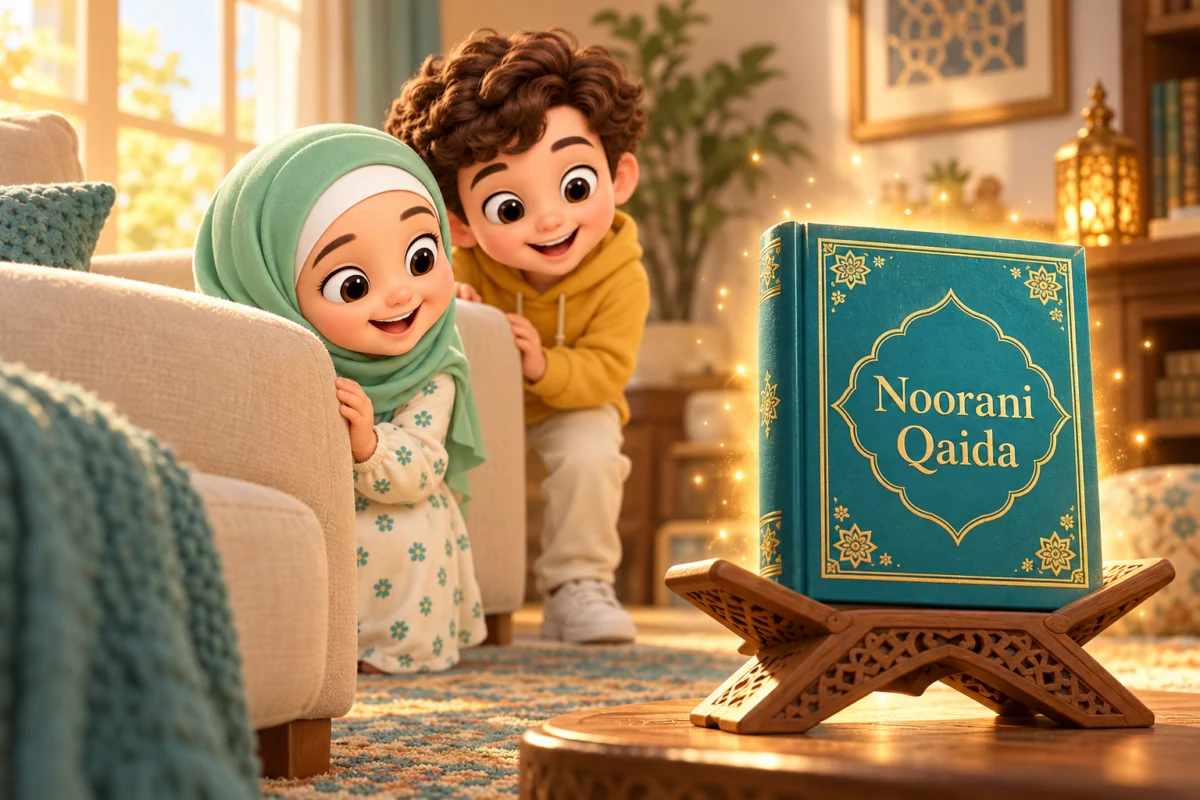
For many children around the world, the answer is a small, colourful book called the Noorani Qaida. In this guide we explain what it is, what your child will learn from it, how long it usually takes, and how you can support your child at home.
- Noorani Qaida is a beginner book that teaches children to read Arabic, step by step, so they can read the Quran.
- It starts with the single letters and ends with reading real words and short verses.
- There is no fixed timeline: every child moves at their own pace.
- A patient teacher who listens and corrects makes all the difference.
What is Noorani Qaida?
Noorani Qaida (sometimes written Qaidah Nooraniyah) is a primer: a short book that teaches the building blocks of reading Arabic. It is named after its author, Sheikh Noor Muhammad Haqqani, and it is used by many families, mosques and teachers worldwide as the first step before reading the Quran.
Other primers follow a very similar path. One you may hear about is Noor Al-Bayan, which is popular in Egypt and the Gulf. Whichever book your child’s teacher uses, the journey below is much the same.
The word qaida simply means rule or foundation in Arabic, and that is exactly what this book gives your child: a strong foundation. Each lesson adds one small new skill to the one before, so children are never asked to do something they have not prepared for.
What does the Noorani Qaida teach?
Editions differ slightly, but most follow the same journey, from the very first letter to reading the Quran:
- The single letters. Your child learns the 28 letters of the Arabic alphabet (many Qaida editions show 29, because they list the hamza separately) and how to pronounce each one from the right place in the mouth and throat.
- Joined letters. Arabic letters change shape depending on where they sit in a word. Children learn to recognise each letter at the start, middle and end of a word.
- Short vowels. Small marks above and below the letters, called harakat, tell us how to say them: بَ بِ بُ (ba, bi, bu).
- Tanween. The doubled vowel marks that add an n sound, such as ban, bin, bun.
- Long vowels (madd). How the letters alif, waw and ya stretch a sound.
- Sukoon and shaddah. The marks that stop a letter or double it.
- First steps in Tajweed. Simple rules of beautiful recitation, preparing your child for Tajweed.
- Reading words and verses. Finally, your child reads real words and short verses from the Quran.

Why it matters so much
It is tempting to rush this stage, especially when a child can already recite some surahs by heart. But the Qaida is where good habits are built. A child who learns each sound correctly now builds a strong foundation for reading with confidence, while small mistakes learned early can be hard to undo later.
And it is more than a reading skill. The Prophet ﷺ said: “The best of you are those who learn the Quran and teach it.” (Sahih al-Bukhari 5027). Every letter your child learns is a step on that path.
How long does Noorani Qaida take?
This is one of the most common questions, and the honest answer is: it depends on your child. Some children move quickly through the letters and slow down at joined letters; others take their time at the start and then speed up. What affects it most is:
- how regularly your child has lessons,
- the length of each lesson,
- a little practice at home between lessons,
- and, above all, your child’s own pace and confidence.
Rather than racing to finish, focus on steady progress. A good teacher sets small, clear goals and lets you see how your child is doing. At Bloomtivo, for example, parents receive a progress report every month.
How you can help at home
You do not need to be an expert in Arabic to make a real difference. A few simple habits go a long way:
- Little and often. Ten calm minutes a day are worth more than one long session a week.
- Listen, then praise. Ask your child to read you today’s line, and celebrate every effort.
- Make it playful. Point out letters on a page, play “find the letter” or use letter cards.
- Keep the same book. Use the same edition as the teacher so practice matches the lessons.
- Be patient. Some letters, like ع and ح, need time. That is completely normal.
Teacher’s tip: if your child gets stuck on a page, go back one page they can read easily. Starting with a win brings the confidence back.
A simple 15-minute practice at home
Between lessons, a short, calm routine like this keeps the Qaida moving without turning home into a classroom.
| Minutes | What to do |
|---|---|
| 2 | Warm up: re-read one line from the last lesson that your child found easy. |
| 5 | Today’s practice: read the new lines aloud, slowly, while you point under each letter. |
| 5 | Revision: go back to one line from an earlier page. |
| 3 | Finish with a game: find a letter on the page, or trace it with a finger. |
For extra letter practice, our free My Arabic Letters workbook has a tracing page for every letter.
A note from Shaimaa Wagdy, Qaida & Tajweed Teacher at Bloomtivo
A child could read the individual letters on a Qaida page, but froze when they appeared joined together. The parent thought the child needed to go back to the beginning.
I looked more closely at the line. The child recognised the letters; the uncertainty came when their shapes changed inside a word. So we did not repeat the whole page. We practised a few joined examples, pointing out how the familiar letter looked in each position. Then we returned to the original line.
The child still needed practice, but the page no longer looked like a wall of unfamiliar shapes.
When a child gets stuck, going back can help—but first find out exactly where the step becomes difficult. The right small correction can save a child from repeating work they already understand.
— Shaimaa Wagdy, Qaida & Tajweed teacher at Bloomtivo
Learning Noorani Qaida online
Many families in the UK now choose live online lessons for the Qaida. With a 1-to-1 teacher, your child has full attention: the teacher hears every sound, gently corrects it straight away and moves on only when your child is ready. Lessons happen at home, around school and weekends, and you can sit nearby whenever you like.
Our Noorani Qaida programme is built exactly this way: live, 1-to-1 and at your child’s pace, with male and female teachers who hold ijazahs in the Quran. When your child finishes, the natural next step is our Quran & Tajweed programme.
Sources and further reading: Sahih al-Bukhari 5027 (Sunnah.com)