Many parents in the UK feel the same quiet worry: I want my child to grow up with the Quran, but my own Arabic is not strong, and life is so busy. If that sounds like you, take a deep breath. You do not need to be a scholar, or to have memorised the whole Quran, to raise a child who loves it. You need patience, the right method, and a little time every day.
This guide walks you through it, step by step.
- Your home is your child’s first Quran school, even if you are still learning yourself.
- Ten calm, encouraging minutes a day matter far more than long, occasional sessions.
- Start with one verse, or even part of a verse, and explain what it means.
- If you are unsure of pronunciation, don’t correct by guessing: a qualified teacher makes a real difference.
Why the home matters so much
Children spend far more time at home than in any class. What they see, hear and feel there shapes how they see the Quran. The Prophet ﷺ said: “Recite the Quran, for it will come on the Day of Resurrection as an intercessor for its companions.” (Sahih Muslim 804). Helping your child become a companion of the Quran starts at home.
Step 1: Set your intention and your goal
Start by asking: what would I love for my child this year? Learning the Arabic letters? Reading from the Mushaf? Memorising Juz Amma? A clear, realistic goal keeps everyone focused and makes progress easy to see.
Step 2: Create a little Quran corner
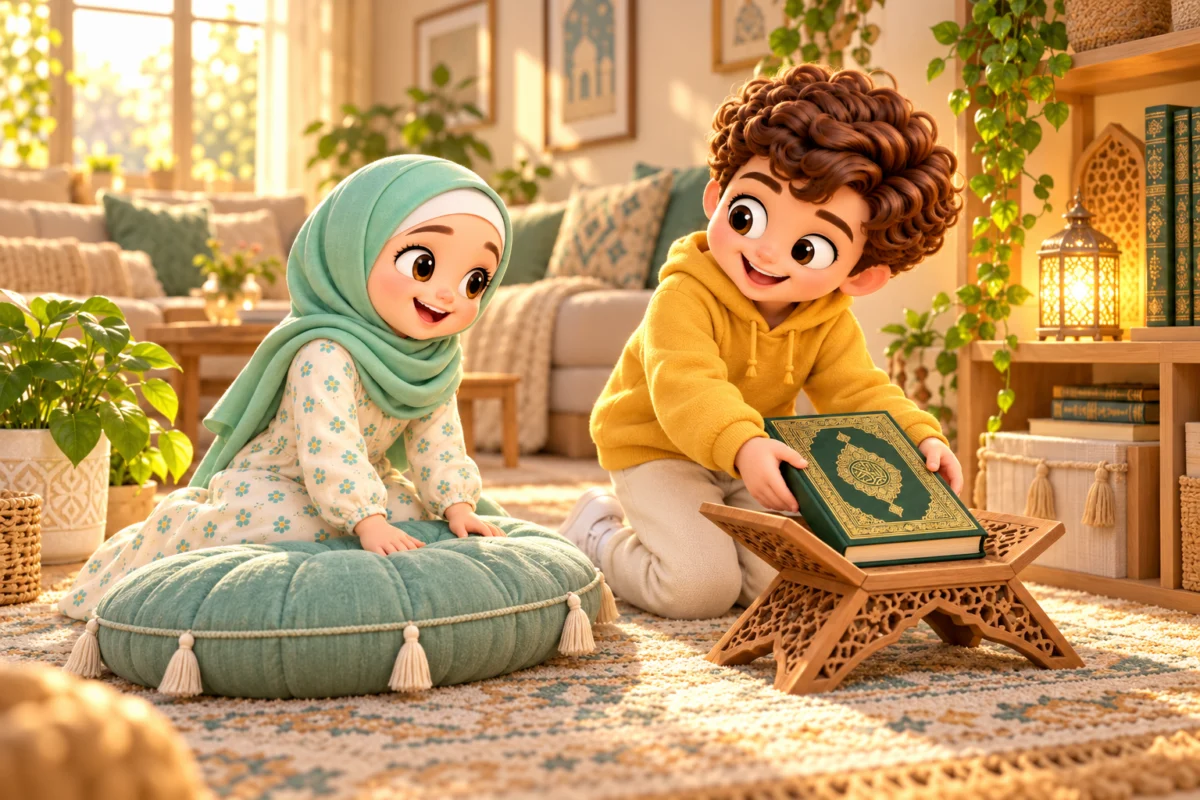
A special place makes learning feel special. It does not need to be big: a cushion, a small shelf, your child’s Qaida or Mushaf, maybe a soft lamp. When your child sits there, they know it is Quran time.
Step 3: Choose a fixed time when your child is relaxed
Tie Quran time to something that already happens every day: after Fajr, after school snack, after Maghrib or before bed. Avoid the moment your child walks in from school, tired and with homework waiting. The same calm time every day turns effort into habit. Ten to fifteen focused minutes are plenty for young children.

Step 4: Start small, with listening
Even before your child can read, they can listen. Choose one verse, or even part of a verse. Play it in the voice of a skilled reciter, and let your child repeat it calmly. Don’t rush to the next verse until the first one is secure. Children absorb sounds naturally, and many learn Al-Fatihah and the last surahs of the Quran simply by hearing them often. Free tools such as Quran.com let you play recitations verse by verse.
Step 5: Explain what it means
Children hold on to what they understand. When your child memorises قُلْ هُوَ اللَّهُ أَحَدٌ (“Say: He is Allah, the One”), explain simply that Allah is One and has no partner. If your child understands English better than Arabic, explain the meaning in English. That is perfectly fine: what matters is that they understand the words of Allah and love them.
Step 6: Teach reading step by step
When your child is ready to read, the usual first step is the Noorani Qaida, which teaches the letters, sounds and rules of reading in order. Read our full guide What is Noorani Qaida? to understand each stage.
Here is the honest part: reading the Quran correctly depends on pronouncing every letter properly, and that is hard to check if you are not confident yourself. If you are unsure of your own pronunciation or the Tajweed rules, don’t correct your child by guessing. Let a qualified teacher teach, and make your role at home following up, encouraging and revising.
Step 7: Make it joyful
- Tell the stories behind the surahs your child learns.
- Celebrate milestones, like a new surah memorised or a finished page.
- Use a sticker chart for daily practice, if your child enjoys it.
- Let your child teach you what they learned today.
For more ideas, see how to help your child love the Quran.
Step 8: Learn alongside your child
If your own reading is rusty, this is a beautiful opportunity. Children love seeing their parents learn. Read a few verses yourself each day, or revise a surah together. Your example teaches more than any lesson.
Teacher’s tip: end every Quran session on a high: a word of praise, a smile, a hug. Your child should leave wanting to come back tomorrow.
A simple 15-minute home routine
If you are not sure what a “good” session at home looks like, start here. It is short on purpose.
| Minutes | What to do | Tip |
|---|---|---|
| 3 | Listen to the surah or lesson your child is learning. | A clear, slow recitation works best. |
| 5 | Read or recite the new part together. | Point under the words as you go. |
| 5 | Revise something older. | Let your child choose which one. |
| 2 | Finish with a dua or a sticker. | End while it still feels good. |
From a teacher: “It wasn’t the child, it was the method”
Picture a mother trying to teach her son Surah Al-Ikhlas. She reads him the verse and asks him to repeat it, and every time he makes a mistake on the same word. “No, not like that! Concentrate!” She repeats it a second time, then a third, until he gets upset and says, “I don’t want to memorise!”
At that point the mother thinks her son doesn’t love the Quran. But the problem isn’t the child at all. The problem is the way he is being taught.
Teaching the Quran at home doesn’t need long hours, and it doesn’t need the mother or father to have memorised the whole Quran. It needs a little patience, the right method and consistency. The steps above are exactly how I would begin.
The advice I repeat to every parent: ten minutes of Quran every day, in a calm atmosphere full of encouragement, is better than an hour of memorising.
— Ahmed Abdelazeem, Quran teacher at Bloomtivo
When is it time to find a teacher?
Home learning is precious, and a teacher usually helps most when:
- your child is ready to read and you are unsure about pronunciation,
- you want your child to learn Tajweed properly,
- your child is starting Hifz and needs a clear plan with revision,
- daily life is busy and you need structure and accountability.
A teacher does not replace your role at home. It completes it: the teacher teaches, and you encourage, listen and celebrate.
The best of both
At Bloomtivo, lessons happen at home, live and 1-to-1, so they fit naturally into family life. Your child learns with a teacher who holds an ijazah in the Quran, and you can sit nearby, follow every lesson and receive a progress report every month. Our Noorani Qaida, Quran & Tajweed and Hifz programmes follow a clear path you can see in our curriculum. You can begin with 2 free trial lessons.
Sources and further reading: Sahih Muslim 804 (Sunnah.com) · Surah Al-Ikhlas (Quran.com) · Quran.com