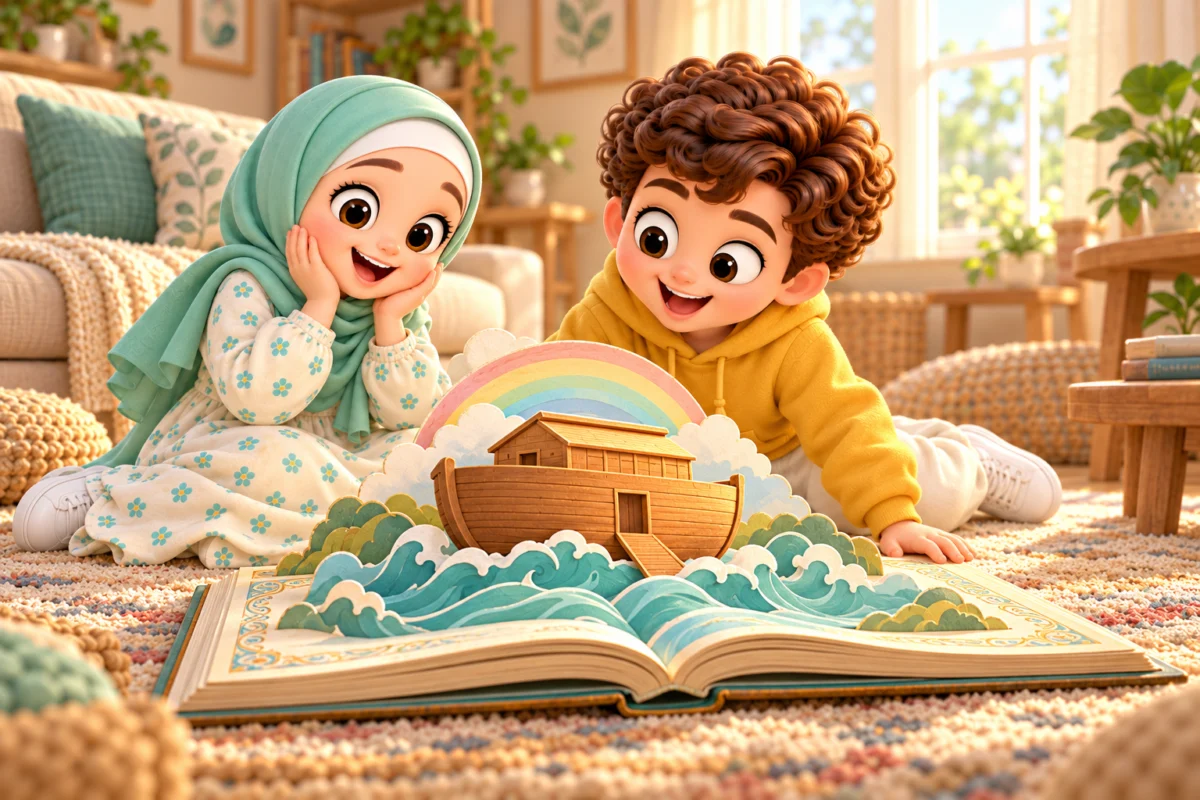
A good place to start is with the prophets whose stories are told most fully in the Quran and are easiest for children to picture: Adam, Nuh, Ibrahim, Yusuf, Musa, Yunus and Isa (peace be upon them all), and of course our Prophet Muhammad ﷺ. Tell each story simply, pick one lesson, and read a verse or two from the Quran together.
There is something special about bedtime with a prophet’s story: the questions, the wide eyes, the “and then what happened?” These stories are one of the gentlest ways to bring the Quran into your child’s heart.
The Quran names 25 prophets, and their stories are full of courage, patience, honesty and trust in Allah. Allah says: “In their stories there is truly a lesson for people of understanding” (Surah Yusuf 12:111). Below is a simple starting list, with the heart of each story, the lesson for children and where to find it in the Quran.
- Start with the best-known stories and tell them in order, from Adam to Muhammad ﷺ.
- Choose one clear lesson per story, such as patience, honesty or saying sorry to Allah.
- Take the stories from the Quran and authentic sources, not made-up details.
- Islam does not picture the prophets, so use words, places and objects instead.
8 prophet stories to start with
1. Prophet Adam: saying sorry to Allah
Allah created Adam, taught him the names of things and placed him in Paradise. When Adam and Hawwa ate from the tree they were told to avoid, they turned straight back to Allah and asked forgiveness: “Our Lord, we have wronged ourselves, and if You do not forgive us and have mercy on us, we will surely be among the losers” (Surah Al-A’raf 7:23).
Lesson for children: everyone makes mistakes; the best thing to do is to say sorry to Allah straight away.
2. Prophet Nuh: patience and the great ark
Nuh called his people to Allah for 950 years (Surah Al-’Ankabut 29:14), even when most of them laughed at him. Allah told him to build a great ship (Surah Hud 11:37), and the believers were saved from the flood.
Lesson for children: keep doing what is right, even when others make fun of you.
3. Prophet Ibrahim: thinking for yourself and trusting Allah
As a young man, Ibrahim looked at a star, the moon and the sun, and saw that none of them could be God, because they all disappear (Surah Al-An’am 6:76–79). When his people threw him into a fire, Allah said: “O fire, be coolness and safety upon Ibrahim” (Surah Al-Anbiya 21:69).
Lesson for children: use your mind to know Allah, and trust Him when things are hard.
4. Prophet Yusuf: honesty, patience and forgiveness
Allah calls this “the best of stories” (Surah Yusuf 12:3), and a whole surah tells it. Yusuf was thrown into a well by his jealous brothers, sold, and later put in prison unfairly, yet he stayed honest and patient. In the end he became a leader in Egypt and forgave his brothers.
Lesson for children: be patient when life feels unfair, and be generous enough to forgive.
5. Prophet Musa: courage and Allah’s help
When Musa was a baby, Allah inspired his mother to place him in the river to keep him safe (Surah Al-Qasas 28:7). He grew up to stand bravely in front of Pharaoh, and when the believers were trapped by the sea, Allah parted it for them (Surah Ash-Shu’ara 26:63).
Lesson for children: be brave for what is right; Allah’s help can come in ways we never expect.
6. Prophet Yunus: turning back to Allah
Yunus left his people in anger, before Allah told him to, and ended up inside a great fish. In the darkness he called out: “There is no god except You; glory be to You. Indeed, I have been of the wrongdoers” (Surah Al-Anbiya 21:87), and Allah saved him.
Lesson for children: wherever you are, Allah hears you. This short dua is a beautiful one for children to learn.
7. Prophet Isa: a miracle from the very start
Isa was born to Maryam without a father, by the will of Allah. As a baby in the cradle he spoke and said: “Indeed, I am the servant of Allah” (Surah Maryam 19:30). By Allah’s permission, he later healed the sick (Surah Al Imran 3:49).
Lesson for children: Allah can do anything, and every prophet called people to worship Allah alone.
8. Prophet Muhammad ﷺ: the final messenger
The story of our Prophet ﷺ deserves its own journey: his honesty before prophethood, the first revelation in the cave of Hira, the migration to Madinah and his kindness to children. You can explore it step by step through his biography, the Seerah.
Lesson for children: he is our best example, in how we speak, share, forgive and pray.
How to tell prophet stories to children
- Keep it short. One story, or one part of a longer story, per sitting is plenty for young children.
- One lesson at a time. Ask, “What did Yusuf do when his brothers said sorry?” rather than listing many morals.
- Read the verse together. Show your child where the story is in the Quran. It makes the Quran feel close and real.
- Stay with authentic sources. Some popular books add details that are not from the Quran or authentic hadith. When in doubt, keep it simple.
- No pictures of prophets. Muslims do not draw or picture the prophets. Instead, use the setting: the ark, the well, the sea, the fish.
- Connect it to life. “Remember Prophet Yunus’s dua? We can say it when we feel worried.”
A note from Islam Awny, Quran & Islamic Studies Teacher at Bloomtivo
A child once stopped me midway through the story of Prophet Yusuf and asked, “If his brothers hurt him so badly, why did he forgive them?”
I nearly answered with the lesson straight away: forgiveness is good. But the question deserved more than a quick moral. So I asked, “Do you think forgiving someone means pretending they did not hurt you?”
The child thought for a moment, then shook their head.
That gave us a better way into the story. We talked about what Yusuf’s brothers had done, how long the separation had lasted, and what it might have taken for him to meet them again without seeking revenge. We returned to the Qur’anic account and let the child sit with the difficult part.
I learnt that children do not always need us to explain the lesson faster. Sometimes they need us to take their question seriously enough to find the lesson together.
— Islam Awny, Quran & Islamic Studies teacher at Bloomtivo
Teacher’s tip: make bedtime “story night” once a week, and let your child choose which prophet. When they start retelling the stories to you, you know they have truly taken them to heart.
A story a week: an 8-week plan
One story each week, told at bedtime and revisited with a small activity, is plenty. Here is a gentle plan using the stories above.
| Week | Story | A simple activity |
|---|---|---|
| 1 | Prophet Adam | Talk about saying sorry: Adam and his wife asked Allah for forgiveness (7:23). |
| 2 | Prophet Nuh | Fold a paper boat and talk about patience and trusting Allah. |
| 3 | Prophet Ibrahim | Talk about how Allah kept him safe in the fire (21:69). |
| 4 | Prophet Yusuf | Draw the eleven stars, the sun and the moon from his dream (12:4). |
| 5 | Prophet Musa | Draw the sea parting and talk about trusting Allah when we are afraid. |
| 6 | Prophet Yunus | Learn his dua from inside the big fish together (21:87). |
| 7 | Prophet Isa | Talk about how he spoke as a baby in the cradle (19:30). |
| 8 | Prophet Muhammad ﷺ | Talk about how Allah sent him as a mercy to the worlds (21:107). |
Our free Prophets Story Cards have a card for each of these stories, ready to print and cut out.
Learn the stories with a teacher
In our Stories of the Prophets programme, children learn the stories from the Quran and authentic sources, one prophet at a time, with the lessons explained at their level. The Seerah programme then takes them through the life of the Prophet Muhammad ﷺ. Both are part of our wider Islamic Studies. Lessons are live and 1-to-1, and you can start with 2 free trial lessons, then continue on a paid plan if it suits your family.
Sources and further reading: Quran 12:111 · Quran 7:23 · Quran 29:14 · Quran 11:37 · Quran 6:76–79 · Quran 21:69 · Quran 12:3 · Quran 28:7 · Quran 26:63 · Quran 21:87 · Quran 19:30 · Quran 3:49