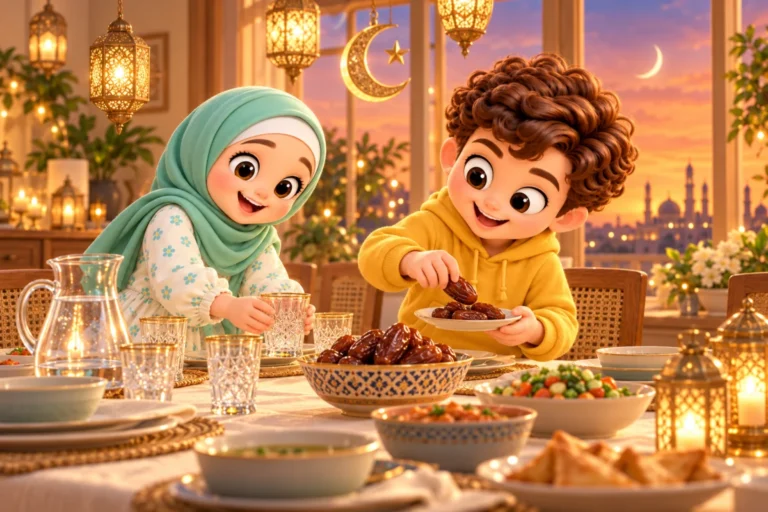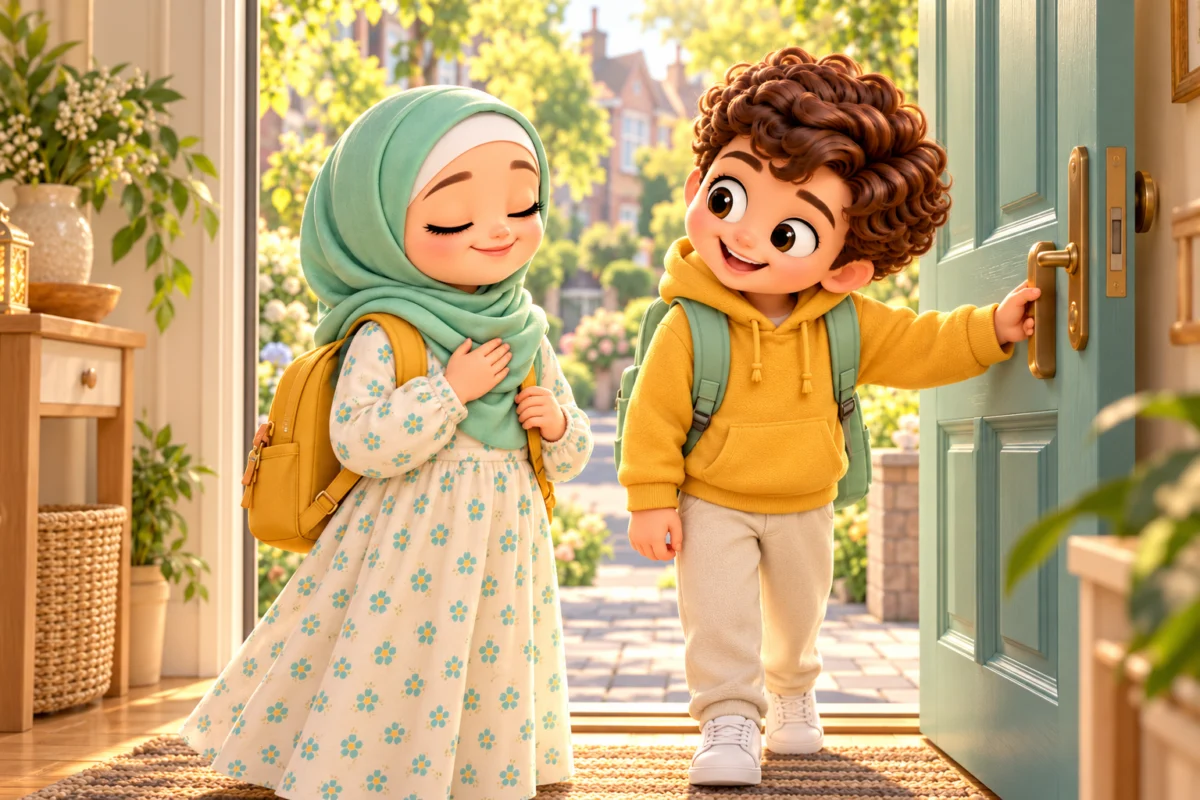
Picture it: dinner is on the table, and before anyone reaches for their plate, your child whispers “Bismillah” all by themselves. Small moments like that are what so many of us hope for. And the beautiful thing is that some of the most powerful words we can teach our children are also the shortest. A few words before eating, before sleeping or when leaving the house can turn an ordinary day into a day full of remembering Allah.
Here are ten daily duas every Muslim child can learn, each with the Arabic, an easy transliteration, the meaning and where it comes from. At the end you will find simple tips to help your child learn them by heart.
- Daily duas connect every part of a child’s day to Allah.
- Start with two or three short duas and add more slowly.
- Teach the meaning too, so children understand what they ask for.
- Say them together at the right moments: practice beats memorising lists.
1. Before eating
بِسْمِ ٱللَّهِ
Bismillah. Meaning: In the name of Allah. The Prophet ﷺ taught a young boy to say Bismillah and eat with his right hand (Sahih al-Bukhari 5376).
2. If you forget at the start of a meal
بِسْمِ ٱللَّهِ أَوَّلَهُ وَآخِرَهُ
Bismillahi awwalahu wa akhirahu. Meaning: In the name of Allah, at its beginning and at its end (Sunan Abi Dawud 3767).
3. After eating
الْحَمْدُ لِلَّهِ الَّذِي أَطْعَمَنِي هَذَا الطَّعَامَ وَرَزَقَنِيهِ مِنْ غَيْرِ حَوْلٍ مِنِّي وَلَا قُوَّةٍ
Alhamdu lillahil-ladhi at‘amani hadhat-ta‘ama wa razaqanihi min ghayri hawlin minni wa la quwwah. Meaning: All praise is for Allah, who fed me this food and provided it for me without any power or strength from me (Sunan Abi Dawud 4023). For very young children, simply saying Alhamdulillah is a lovely start.
4. Before sleeping
بِاسْمِكَ اللَّهُمَّ أَمُوتُ وَأَحْيَا
Bismika Allahumma amutu wa ahya. Meaning: In Your name, O Allah, I die and I live (Sahih al-Bukhari 6324).
5. When waking up
الْحَمْدُ لِلَّهِ الَّذِي أَحْيَانَا بَعْدَ مَا أَمَاتَنَا وَإِلَيْهِ النُّشُورُ
Alhamdu lillahil-ladhi ahyana ba‘da ma amatana wa ilayhin-nushur. Meaning: All praise is for Allah, who gave us life after causing us to die, and to Him is the return (Sahih al-Bukhari 6324).

6. When leaving the house
بِسْمِ اللَّهِ تَوَكَّلْتُ عَلَى اللَّهِ وَلَا حَوْلَ وَلَا قُوَّةَ إِلَّا بِاللَّهِ
Bismillah, tawakkaltu ‘alallah, wa la hawla wa la quwwata illa billah. Meaning: In the name of Allah, I put my trust in Allah, and there is no power and no strength except with Allah (Sunan Abi Dawud 5095). A perfect dua for the walk to school.
7. Entering the toilet
اللَّهُمَّ إِنِّي أَعُوذُ بِكَ مِنَ الْخُبُثِ وَالْخَبَائِثِ
Allahumma inni a‘udhu bika minal-khubuthi wal-khaba’ith. Meaning: O Allah, I seek Your protection from all evil and evil beings (Sahih al-Bukhari 142). It is said before entering, not inside.
8. Leaving the toilet
غُفْرَانَكَ
Ghufranak. Meaning: I ask for Your forgiveness (Sunan Abi Dawud 30).
9. When sneezing
The one who sneezes says الْحَمْدُ لِلَّهِ (Alhamdulillah, all praise is for Allah). The one who hears replies يَرْحَمُكَ اللَّهُ (Yarhamukallah, may Allah have mercy on you). Then the sneezer answers يَهْدِيكُمُ اللَّهُ وَيُصْلِحُ بَالَكُمْ (Yahdikumullahu wa yuslihu balakum, may Allah guide you and set your affairs right) (Sahih al-Bukhari 6224). Children love this one because it is a little conversation.
10. Two duas from the Quran
For knowledge:
رَبِّ زِدْنِي عِلْمًا
Rabbi zidni ‘ilma. Meaning: My Lord, increase me in knowledge (Surah Ta-Ha 20:114). Lovely to say before every lesson.
For parents:
رَبِّ ارْحَمْهُمَا كَمَا رَبَّيَانِي صَغِيرًا
Rabbir-hamhuma kama rabbayani saghira. Meaning: My Lord, have mercy on them as they raised me when I was small (Surah Al-Isra 17:24).
How to help your child learn these duas
- One dua a week. Choose one, say it together at the right moment every day, and only move on when it is easy.
- Say it out loud yourself. Children copy what they hear at the dinner table and at bedtime.
- Explain the meaning in one sentence. Knowing what they ask for makes the dua real.
- Use gentle reminders. A small card on the fridge or by the front door works wonders.
- Celebrate. When your child says a dua without being reminded, notice it and praise them.
A note from Islam Awny, Quran & Islamic Studies Teacher at Bloomtivo
A parent told me their child could recite the dua for leaving home when asked, but almost never remembered it at the door.
We changed where the practice happened. Instead of repeating the dua at a desk, the family placed a small card beside the front door. For a few days, the parent read it with the child before they left. Then the parent began pausing at the door to give the child a chance to remember.
The child did not need a prize or a test. The doorway itself became the reminder. After a while, the parent could reach for the keys and hear the child begin the dua without being prompted.
That is one reason I like teaching duas in the moments they belong to. The child is not only learning words; they are learning when to turn to Allah.
— Islam Awny, Quran & Islamic Studies teacher at Bloomtivo
Teacher’s tip: let your child remind you. Children love catching parents who forget the dua before eating, and it helps them remember it even better.
A 10-week dua plan you can follow
One dua a week, practised at the real moment it belongs to. By the end of ten weeks, your child’s whole day is wrapped in duas.
| Week | Dua | When to practise |
|---|---|---|
| 1 | Bismillah | Before every meal and snack |
| 2 | Alhamdulillah, then the full dua after eating | After meals |
| 3 | Before sleeping | At bedtime, lights off |
| 4 | When waking up | First thing in the morning |
| 5 | Leaving the house | At the front door on the way to school |
| 6 | Sneezing and replying | Whenever someone sneezes |
| 7 | Entering and leaving the toilet | At the bathroom door |
| 8 | If you forget Bismillah | When your child remembers mid-meal |
| 9 | Rabbi zidni ‘ilma | Before homework or a Quran lesson |
| 10 | The dua for parents | After salah, or at bedtime |
If a week feels too fast, simply stay on that dua for another week. There is no rush.
Learn duas with a teacher
Our Duas & Adhkar programme helps children memorise daily duas with correct pronunciation and understand their meanings, in live 1-to-1 lessons. It goes beautifully with Salah & Wudu and Noorani Qaida. Read also how to teach your child to pray, or start with 2 free trial lessons.
Sources: Bukhari 5376 · Abu Dawud 3767 · Abu Dawud 4023 · Bukhari 6324 · Abu Dawud 5095 · Bukhari 142 · Abu Dawud 30 · Bukhari 6224 · Quran 20:114 · Quran 17:24